

Capsule Endoscopy Market to reach USD 2.17 Billion by 2035 at 12.0% CAGR
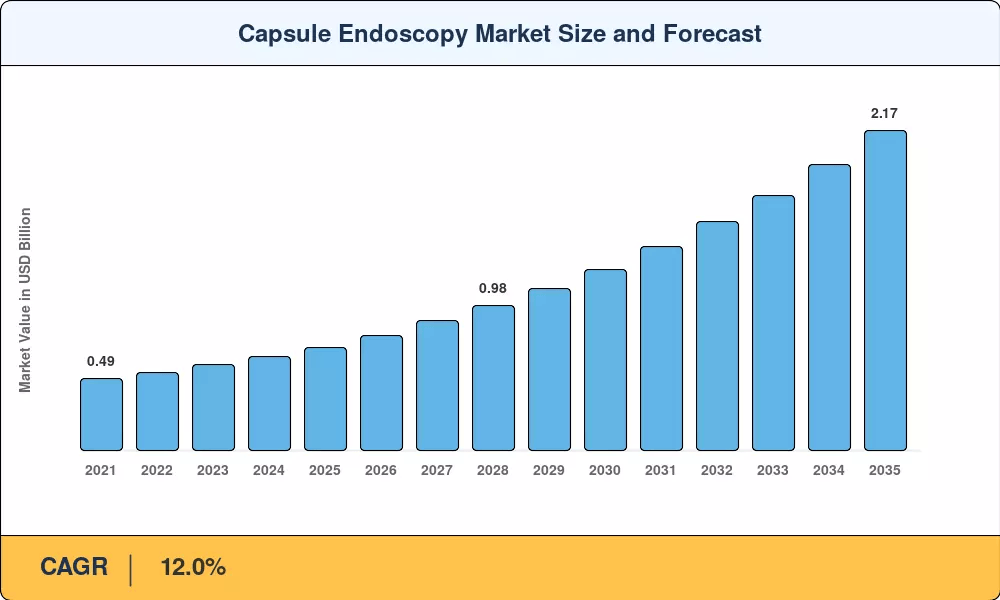
Capsule Endoscopy Market Size
Capsule Endoscopy Market to Surge from USD 0.78 Bn in 2026 to USD 2.17 Bn by 2035-Powered by Rising GI Disorder Prevalence, AI-Powered Automated Image Reading
NY, CA, UNITED STATES, June 22, 2026 /EINPresswire.com/ -- As per Market Research Future, the global Capsule Endoscopy Market size to reach USD 2.17 Billion by 2035 from USD 0.78 Billion in 2026, at a CAGR of 12.0% during the forecast period 2026--2035. The market base was estimated at USD 0.70 Billion in 2025.The 12.0% CAGR---anchored by structural diagnostic demand rather than discretionary healthcare spending---is driven by three converging forces: rising global gastrointestinal disorder prevalence that continues to widen the addressable patient base for wireless capsule imaging, sustained AI-powered automated image reading expansion that has pulled capsule endoscopy from niche referral into mainstream diagnostic protocols, and reimbursement expansion for swallowable camera endoscopy that has converted pill camera diagnostics from cost centers into reimbursement priorities tied to early GI cancer detection.
National governments and multilateral health organizations are amplifying this momentum. The WHO's 2024 resolution urging member states to prioritize early GI cancer screening has galvanized national screening programs across Asia-Pacific and Europe. The US FDA increased its 510(k) clearances for AI-assisted capsule reading software in 2024, decreasing average image review time from 90 minutes to less than 25 minutes. Cumulative venture investment exceeding USD 480 million into swallowable camera endoscopy platforms between 2022 and 2024 has created the procurement infrastructure and delivery innovation on which the Capsule Endoscopy Market depends.
Request A Free Sample:
https://www.marketresearchfuture.com/sample_request/1359
Key Market Trends & Growth Drivers
Rising GI Disorder Prevalence and Aging Demographics
Colorectal cancer (CRC) remains a significant global health challenge. The International Agency for Research on Cancer (IARC) projects a continued rise in the global CRC burden, driven by shifting lifestyle factors and an aging population. As the global population aged 50 and above increases, clinical demand for diagnostic gastrointestinal (GI) procedures is rising. Wireless capsule endoscopy (WCE) has emerged as an important non-invasive modality for evaluating the small bowel, offering an alternative to traditional, more invasive enteroscopy in patients for whom direct visualization is required but standard methods may be challenging.
National cancer registries in India and Brazil are also capturing higher detection rates as screening programs mature, feeding into the Capsule Endoscopy Market growth pipeline across emerging economies. Each percentage point of GI disorder prevalence gain translates into measurable prescription volume for wireless capsule imaging, and the GI tract video capsule procedure schedule embedded in routine gastroenterology care makes this driver structurally durable through 2035.
AI-Powered Automated Image Reading Expansion
Legacy manual image review, long the default reading modality, is giving ground to AI-enhanced automated analysis platforms that detect GI tract abnormalities at subclinical stages. Medtronic's RAPID software established proof-of-concept for AI-assisted capsule reading, and the pipeline now includes cloud-based AI reading platforms under active clinical evaluation. The US FDA increased its 510(k) clearances for AI-assisted capsule reading software in 2024, decreasing average image review time from 90 minutes to less than 25 minutes, providing a compelling argument for labor savings that hospital administrators cannot ignore.
Reimbursement Expansion and Outpatient Care Shift
CMS reimbursement expansion for capsule endoscopy under the hospital outpatient prospective payment system and physician fee schedule ties provider reimbursement to diagnostic accuracy metrics. European data from NHS England show that colon capsule endoscopy deployment across 40+ trusts has reduced colonoscopy backlog accumulated during the pandemic, saving approximately USD 800--1,200 per patient in facility costs.
This economic incentive has driven hospital formulary committees to prioritize wireless capsule imaging protocols, shifting procurement budgets toward the Capsule Endoscopy Market at the expense of reactive surgical intervention spending. Reimbursement expansion in the United States and European reference pricing for GI diagnostics have shifted institutional procurement toward early, non-invasive detection.
Ask for Customization:
https://www.marketresearchfuture.com/ask_for_customize/1359
Market Segment Insights
BY PRODUCT
Capsule Endoscopes: Dominant segment with ~64% revenue share in 2025. Reflecting entrenched physician familiarity with small bowel capsule protocols. Medtronic's PillCam SB3 and Jinshan's OMOM platform collectively represent the majority of global unit shipments, anchoring institutional formularies globally due to decades of clinical evidence supporting wireless capsule imaging for obscure GI bleeding diagnosis. Hospital procurement teams treat it as a default first-line agent, and expanding clinical indications have enabled broad adoption even in cost-sensitive emerging markets.
Recorders and Workstations: Fastest-growing product segment at 13.1% CAGR (2026--2035). Driven by cloud-based AI reading platform migration and expanding swallowable camera endoscopy indications. The transition from proprietary belt-worn recorders to tablet-based and cloud-connected platforms has reduced hardware costs while creating software upgrade revenue streams. AI-enabled reading workstations are becoming the primary differentiator in competitive bids, as hospitals increasingly evaluate pill camera diagnostics platforms on total workflow efficiency rather than capsule hardware specifications alone.
BY APPLICATION
Gastrointestinal Bleeding and Tumors: Dominant application with ~48% revenue share in 2025. International guidelines from the American College of Gastroenterology and ESGE recommend small bowel capsule endoscopy as the first-line investigation for obscure GI bleeding after negative upper and lower endoscopy. The inherent diagnostic need for non-invasive small bowel visualization drives sustained dual-channel demand for GI tract video capsule procedures.
Crohn's Disease: Fastest-growing application segment at 13.5% CAGR (2026--2035). Reflecting biologics-era monitoring protocols that require non-invasive mucosal assessment. Immune-modulating biologics extending remission periods in Crohn's Disease create a larger prevalent population requiring sustained wireless capsule imaging for mucosal healing evaluation. GI tract video capsule imaging allows non-invasive serial monitoring that patients tolerate far better than repeated ileocolonoscopy.
BY END USER
Hospitals: Largest segment with ~58% share in 2025. Comprehensive gastroenterology service lines and integrated radiology reading infrastructure dominate volume. Hospitals remain the primary delivery site for pill camera diagnostics due to on-site GI expertise, established endoscopy departments, and inpatient workup protocols.
Ambulatory Surgery Centers: Fastest-growing end-user segment at 14.3% CAGR (2026--2035). Outpatient shift and cost optimization drive demand as swallowable camera endoscopy reduces the need for supervised endoscopy suite capacity. ASCs and community gastroenterology clinics increasingly prescribe outpatient pill camera diagnostics to manage endoscopy-center capacity.
Read Detailed Insights:
https://www.marketresearchfuture.com/reports/capsule-endoscopy-market-1359
Regional Outlook
North America -- Dominant Market (~38% Share, 2025)
The United States generates approximately 82% of North American Capsule Endoscopy Market revenue, driven by CMS reimbursement expansion, FDA AI clearances for capsule reading software, and broad coverage for wireless capsule imaging procedures---a single policy ecosystem that converted a referral-only diagnostic modality into one with a structural outpatient screening tail.
CMS processed over 185,000 capsule endoscopy claims in 2024, a 14% increase year-on-year, driven by expanded CPT code coverage and growing physician familiarity with pill camera diagnostics. Academic medical centers build centralized reading center capacity, while community gastroenterology networks increasingly prescribe outpatient pill camera diagnostics to manage endoscopy suite capacity. The US dominates through a combination of high per-patient spending, robust payer coverage, and rapid AI-integrated capsule adoption.
Europe -- Second Largest (~28% Share, 2025)
Europe's Capsule Endoscopy Market reflects divergent national strategies---Germany leads regionally with strong KOL-driven adoption and statutory health insurance coverage, contributing ~22% of regional share in 2025, while the UK historically used selective wireless capsule imaging targeting before broadening coverage through NHS colon capsule endoscopy rollout across 40+ trusts at 13.0% CAGR.
France contributes ~16% of regional share through Haute Autorite de Sante guideline inclusion for obscure GI bleeding. Italy contributes steady growth on regional screening program expansion at 11.8% CAGR. Spain is growing on public-private gastroenterology partnerships at USD 0.02 Billion in 2025.
Asia-Pacific -- Fastest-Growing Region (14.2% CAGR, 2026--2035)
Asia-Pacific is the engine of the Capsule Endoscopy Market. China holds the largest regional share with ~36% of regional revenue, driven by NHSA reimbursement inclusion and domestic manufacturer growth---Jinshan Science & Technology has built a domestic manufacturing base that supplies GI tract video capsule devices at price points 35--40% below imported alternatives, enabling rapid tier-2 and tier-3 city penetration.
India is growing at 15.8% CAGR on the back of rising GI cancer incidence and medical tourism. Japan contributes ~24% of regional share through MHLW coverage and aging population demand. South Korea is growing at 13.6% CAGR on National Cancer Screening Program expansion.
Middle East & Africa -- Emerging Opportunity (10.8% CAGR, 2026--2035)
The Middle East & Africa is bifurcated between well-funded Gulf states and resource-constrained Sub-Saharan nations. Saudi Arabia leads the region with Vision 2030 healthcare investment, contributing ~30% of regional share---over USD 65 billion allocated to medical infrastructure, with gastroenterology among prioritized specialties. The UAE is growing at 12.5% CAGR on medical tourism and premium hospital expansion. South Africa contributes USD 0.005 Billion on private hospital chain adoption.
South America -- Growing Presence (USD 0.04 Billion, 2025)
Brazil anchors South America's Capsule Endoscopy Market at ~62% of regional revenue, with leading hospitals in Sao Paulo and Rio de Janeiro integrating pill camera diagnostics into their GI departments. The SUS (Unified Health System) has initiated pilot programs exploring capsule endoscopy for underserved rural populations in Brazil's northeast, where access to conventional endoscopy facilities remains limited, providing a stable demand floor that smooths regional forecasts.
Competitive Landscape and Recent Developments
The Capsule Endoscopy Market exhibits moderate concentration, with the top five companies accounting for around 65--72% of total revenue. The Herfindahl-Hirschman Index sits in the 1,800--2,200 range, reflecting a market led by two major platforms (Medtronic's PillCam and Olympus's EndoCapsule) flanked by strong contenders from China, South Korea and the US. Patent expirations and cost-optimized domestic alternatives are gradually fragmenting premium segments, though pipeline innovation in AI-integrated reading and magnetically guided navigation sustains competitive moats for first-movers.
The competitive landscape is stratified between wireless capsule imaging pioneers serving global GI diagnostics markets, AI software platform specialists capturing reading workflow contracts, and cost-optimized manufacturers consolidating the emerging market segment.
KEY COMPANIES AND RECENT MILESTONES
Medtronic (Given Imaging) (2024--2025): Maintains leadership with PillCam SB3, PillCam COLON 2, and RAPID reading software, commanding ~28--33% of global Capsule Endoscopy Market revenue. Market leader with the broadest clinical evidence base; premium platform positioning in specialty segments offsets price compression in competitive markets.
Olympus Corporation (2024--2025): EndoCapsule 10 and reading workstation suite reinforce the leveraging established endoscopy distribution network positioning, holding ~14--18% of global revenue. The company benefits from cross-selling through its interventional GI channel and comprehensive endoscopy portfolio.
CapsoVision (December 2023): Received CE Mark for its updated CapsoCam Plus 4-camera panoramic capsule, featuring improved battery life enabling 16+ hours of continuous small bowel imaging. Differentiates on 4-camera panoramic imaging, holding ~6--9% of global revenue.
Future Outlook: 2026--2035
By 2030, precision AI-integrated capsule diagnostics will become the operating system of GI disease management. The convergence of cloud-based AI reading platforms and magnetically guided navigation will reshape the Capsule Endoscopy Market through the late 2020s. By 2030, an estimated 40% of newly diagnosed obscure GI bleeding cases will undergo AI-assisted capsule reading followed by matched therapeutic intervention, creating a diagnostic-therapeutic revenue loop.
The FDA's expanded 510(k) clearance pathway for AI-assisted capsule reading software ensures domestic innovation scales alongside clinical demand. Machine-learning models that integrate genomic, proteomic, and imaging biomarkers can recommend optimal sequencing of wireless capsule imaging, conventional endoscopy, and biologic therapy for individual patients. Start-ups have raised over USD 480 million in venture funding for swallowable camera endoscopy platforms between 2022 and 2024.
More Related Research Insights:
https://www.marketresearchfuture.com/reports/endoscopy-devices-market-1967
https://www.marketresearchfuture.com/reports/gastrointestinal-drugs-market-558
https://www.marketresearchfuture.com/reports/medical-imaging-market-1995
https://www.marketresearchfuture.com/reports/minimally-invasive-surgery-devices-market-7875
https://www.marketresearchfuture.com/reports/diagnostic-imaging-market-6765
https://www.marketresearchfuture.com/reports/colonoscopy-devices-market-9202
https://www.marketresearchfuture.com/reports/gastrointestinal-device-market-42375
https://www.marketresearchfuture.com/reports/medical-robotics-market-1311
https://www.marketresearchfuture.com/reports/in-vitro-diagnostics-market-1165
https://www.marketresearchfuture.com/reports/patient-monitoring-devices-market-2484
Larry Wilson
WantStats Research And Media Pvt. Ltd.
+1 855-661-4441
email us here
Visit us on social media:
LinkedIn
Facebook
YouTube
X
Legal Disclaimer:
EIN Presswire provides this news content "as is" without warranty of any kind. We do not accept any responsibility or liability for the accuracy, content, images, videos, licenses, completeness, legality, or reliability of the information contained in this article. If you have any complaints or copyright issues related to this article, kindly contact the author above.
